

Meteorites and asteroids
Giant pieces of rock falling from space made exciting plots for ‘90s sci-fi movies like ‘Armageddon’ and ‘Deep Impact’. Meteorite impact or The ‘Alvarez’ hypothesis met criticism when the theory was first raised in 1980, but it has since been widely accepted that a meteorite strike could have actually wiped out the whole dinosaur population over 65 million years ago.
The last known meteorite to hit Earth, causing significant damage, was in 1908 when a meteorite the size of a ten-storey building exploded over Siberia, flattening 80 million trees over 2,000 square kilometres near the Tunguska River. Luckily, the region was so remote that the strike didn’t harm anyone. Programme scientist for Near Earth Objects at NASA told Yahoo! News: “Such an event releases energies on the order of a few megatons of TNT, because of the velocity at which they impact – many kilometres per second. The Hiroshima atomic bomb released the equivalent of about 15 kilotons of TNT. So even relatively small asteroids could cause the damage equivalent to a very large nuclear weapon if they were to strike the Earth.”

Russian scientists have issued some more apocalyptic predictions. An asteroid dubbed ‘Apophis’, estimated to be the size of two football fields, could collide with Earth as early as 16 April 2036 if a change in gravity causes it to fall out of its orbit. While they admit it is theoretically possible for the asteroid to hit Earth, they note that the chances are remote; in fact, they put the odds at one in 233,000. Sergei Smirnov, a spokesman at St. Petersburg's Pulkovo Observatory, said: “How much of a threat this asteroid actually presents will be impossible to assess until 2028, when it approaches our planet. If it does strike, our planet will face a continental disaster and major climate change. And if the asteroid falls into an ocean, the disaster could assume global proportions.”

Solar storms
Powerful solar storms exactly like the ones the world witnessed at the beginning of 2011 occur once every eleven years as the sun’s magnetic field flips over. ‘Solar Cycle 24’ has been building gradually with the number of sunspots and solar storms set to reach a ‘solar maximum’ by 2013. Super solar flares send great geysers of hot gas and huge quantities of charged particles erupting from the surface into space. These flares of charged particles, called ‘coronal mass ejections’, slam into the Earth's magnetic shield impairing electrical devices in their path.
In 1859, the ‘Carrington Event’, a solar flare which lasted eight days, wreaked havoc on all of the world’s telegraphs and set buildings on fire. The National Academy of Sciences says that in modern times the solar flares could knock out 300 important transformers within 90 seconds and cut power for 130 million people. They also estimated that during the first year after a solar storm, damage could be as high as £1.2 trillion with a recovery time of four to ten years. A spokeswoman from the Heliophysics division at NASA told Yahoo! News: “Saying solar flares would end the world is a little drastic. But in terms of affecting us as humans, it is very damaging to our lifestyles; it can destroy communications that we are very dependent on, like power lines and GPS satellites.”
As the sun is said to become more turbulent as it approaches the peak in its activity cycle around 2013, the UK government’s chief scientific adviser, Professor Sir John Beddington, warned: “We've had a relatively quiet period of space weather. We can't expect that quiet period to continue. At the same time over that period the potential vulnerability of our systems has increased dramatically, whether it is the smart grid in our electricity systems or the ubiquitous use of GPS in just about everything we use these days. The situation has changed. We need to be thinking about the ability both to categorise and explain and give early warning when particular types of space weather are likely to occur.”
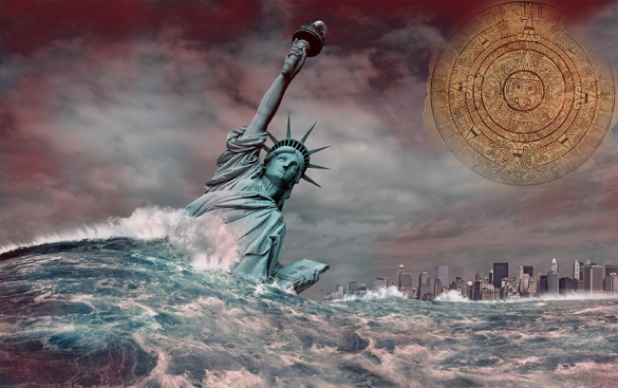
According to some modern astronomers and an ancient Mayan prophecy, on the winter solstice of 21 December 2012, Earth will be in exact alignment with the sun and the centre of the Milky Way galaxy - an extraordinary event which happens once every 25,800 years. No one knows exactly what effect this alignment will have on Earth, but the Mayans believed that the consequences of the inter-galactic occurrence would be catastrophic, prompting the world’s end. It is imagined that a magnetic field effect reversal will take place, where the entire mantle of the earth would shift in a matter of days, changing the position of the North and the South Pole. Such a rapid change in the Earth’s dynamics would result in earthquakes, tsunamis, global climatic change and eventually the ultimate planetary disaster, similar to the one depicted in the disaster movie ‘2012’.
Despite their beliefs, polar shift has been backed by some scientists, albeit not at the rapidity the Mayans believed. Renowned scientist Albert Einstein is known to have been an advocator of the theory and according to a 2006 study by Princeton University, geologist, Adam Maloof said that the Earth’s poles have shifted before. The study found that the North Pole could have rested in the middle of the Pacific Ocean 800 million years ago, placing the state of Alaska as far south as the equator.
However, NASA disagrees, predicting that the polar shift event will not mean that Earth meets it fate. Experts debunked the theory, saying: “Nothing bad will happen to Earth in 2012. Our planet has been getting along just fine for more than four billion years, and credible scientists worldwide know of no threat associated with 2012. There are no planetary alignments in the next few decades, Earth will not cross the galactic plane in 2012, and even if these alignments were to occur, their effects on the Earth would be negligible.”

2010’s eruption of Eyjafjallajokull in Iceland brought air travel across Northern Europe to a virtual standstill, but if one of the largest known super volcanoes was to blow, it could cause a global disaster of biblical proportions. According to volcanologists, the last super volcano to erupt was Mount Toba in Sumatra, Indonesia, 75,000 years ago. Thousands of cubic kilometres of ash and sulphur dioxide were thrown into the atmosphere - so much that it blocked out light from the sun all over the world, resulting in global temperatures plummeting by 21°c. It is imagined that black acidic rain would have fallen due to gas poisoning. Such an event supposedly eradicated mankind, cutting the population to just a couple of thousand people, and three quarters of all living plants in the northern hemisphere are thought to have been killed.
Now international scientists speak about the possibility of a future eruption of one of the largest known prehistoric volcanoes - the Yellowstone caldera in Wyoming, which sits above a large magma chamber and is showing more signs of activity. Observers say that an eruption would result in a mega disaster coating half the US in a layer of ash up to one metre deep, killing livestock and putting thousands of human lives at risk. Scientists say that it typically erupts every 600,000 years, but the last eruption occurred 640,000 years ago, meaning the next one is long overdue.
Global warming
Should the Earth’s average temperature continue to rise at the rate it has done over the last 50 years, the face of the Earth as we know it will change, say climatologists. The reasons for this type of man-made climate change have been well-documented and the Intergovernmental Panel on Climate Change (IPCC) says it’s not too late to save our planet as leading figures try to stop the ill-effects that the Earth’s population and living species will experience from the so-called ‘greenhouse effect’ before the world becomes unbearable for man to live in.
The IPCC has drafted the worst-case scenario. According to an assessment of how global warming could progress beyond 2100 - the normal time frame of model predictions - if temperatures rise by even 6°C rainforests will be wiped out, fertility of many soils will be destroyed and the Arctic will be left ice-free even in midwinter. London will be as hot as Cairo with air quality so poor it would endanger human respiratory systems. The world’s most populous low-lying cities like Tokyo, New York, Mumbai, Shanghai and Dhaka will be engulfed by floods after an eleven-metre rise in sea levels. Extreme weather events, like hurricanes and droughts will become more common, with climate change spreading more infectious diseases.

from yahoo


