Showing posts with label Powerful Tornado. Show all posts

How will our Earth Ends

With a year packed full of strong solar flares affecting communications, future volcanic predictions and giant asteroids passing dangerously close to Earth, what kind of cataclysmic events are most likely to push humans to the brink of extinction? We look at some of the most popular doomsday theories and examine whether these five natural phenomena could end the world as we know it – or whether they are just pure science fiction.

Meteorites and asteroids

Giant pieces of rock falling from space made exciting plots for ‘90s sci-fi movies like ‘Armageddon’ and ‘Deep Impact’. Meteorite impact or The ‘Alvarez’ hypothesis met criticism when the theory was first raised in 1980, but it has since been widely accepted that a meteorite strike could have actually wiped out the whole dinosaur population over 65 million years ago.

The last known meteorite to hit Earth, causing significant damage, was in 1908 when a meteorite the size of a ten-storey building exploded over Siberia, flattening 80 million trees over 2,000 square kilometres near the Tunguska River. Luckily, the region was so remote that the strike didn’t harm anyone. Programme scientist for Near Earth Objects at NASA told Yahoo! News: “Such an event releases energies on the order of a few megatons of TNT, because of the velocity at which they impact – many kilometres per second. The Hiroshima atomic bomb released the equivalent of about 15 kilotons of TNT. So even relatively small asteroids could cause the damage equivalent to a very large nuclear weapon if they were to strike the Earth.”


Latest Science news

Russian scientists have issued some more apocalyptic predictions. An asteroid dubbed ‘Apophis’, estimated to be the size of two football fields, could collide with Earth as early as 16 April 2036 if a change in gravity causes it to fall out of its orbit. While they admit it is theoretically possible for the asteroid to hit Earth, they note that the chances are remote; in fact, they put the odds at one in 233,000. Sergei Smirnov, a spokesman at St. Petersburg's Pulkovo Observatory, said: “How much of a threat this asteroid actually presents will be impossible to assess until 2028, when it approaches our planet. If it does strike, our planet will face a continental disaster and major climate change. And if the asteroid falls into an ocean, the disaster could assume global proportions.”


Solar storms

Powerful solar storms exactly like the ones the world witnessed at the beginning of 2011 occur once every eleven years as the sun’s magnetic field flips over. ‘Solar Cycle 24’ has been building gradually with the number of sunspots and solar storms set to reach a ‘solar maximum’ by 2013. Super solar flares send great geysers of hot gas and huge quantities of charged particles erupting from the surface into space. These flares of charged particles, called ‘coronal mass ejections’, slam into the Earth's magnetic shield impairing electrical devices in their path.

In 1859, the ‘Carrington Event’, a solar flare which lasted eight days, wreaked havoc on all of the world’s telegraphs and set buildings on fire. The National Academy of Sciences says that in modern times the solar flares could knock out 300 important transformers within 90 seconds and cut power for 130 million people. They also estimated that during the first year after a solar storm, damage could be as high as £1.2 trillion with a recovery time of four to ten years. A spokeswoman from the Heliophysics division at NASA told Yahoo! News: “Saying solar flares would end the world is a little drastic. But in terms of affecting us as humans, it is very damaging to our lifestyles; it can destroy communications that we are very dependent on, like power lines and GPS satellites.”

As the sun is said to become more turbulent as it approaches the peak in its activity cycle around 2013, the UK government’s chief scientific adviser, Professor Sir John Beddington, warned: “We've had a relatively quiet period of space weather. We can't expect that quiet period to continue. At the same time over that period the potential vulnerability of our systems has increased dramatically, whether it is the smart grid in our electricity systems or the ubiquitous use of GPS in just about everything we use these days. The situation has changed. We need to be thinking about the ability both to categorise and explain and give early warning when particular types of space weather are likely to occur.”
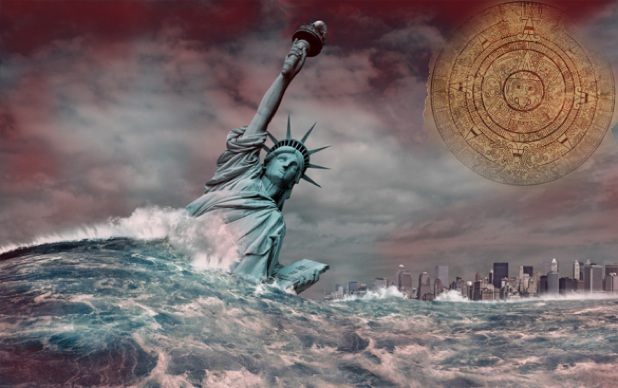
Pole shift

According to some modern astronomers and an ancient Mayan prophecy, on the winter solstice of 21 December 2012, Earth will be in exact alignment with the sun and the centre of the Milky Way galaxy - an extraordinary event which happens once every 25,800 years. No one knows exactly what effect this alignment will have on Earth, but the Mayans believed that the consequences of the inter-galactic occurrence would be catastrophic, prompting the world’s end. It is imagined that a magnetic field effect reversal will take place, where the entire mantle of the earth would shift in a matter of days, changing the position of the North and the South Pole. Such a rapid change in the Earth’s dynamics would result in earthquakes, tsunamis, global climatic change and eventually the ultimate planetary disaster, similar to the one depicted in the disaster movie ‘2012’.

Despite their beliefs, polar shift has been backed by some scientists, albeit not at the rapidity the Mayans believed. Renowned scientist Albert Einstein is known to have been an advocator of the theory and according to a 2006 study by Princeton University, geologist, Adam Maloof said that the Earth’s poles have shifted before. The study found that the North Pole could have rested in the middle of the Pacific Ocean 800 million years ago, placing the state of Alaska as far south as the equator.

However, NASA disagrees, predicting that the polar shift event will not mean that Earth meets it fate. Experts debunked the theory, saying: “Nothing bad will happen to Earth in 2012. Our planet has been getting along just fine for more than four billion years, and credible scientists worldwide know of no threat associated with 2012. There are no planetary alignments in the next few decades, Earth will not cross the galactic plane in 2012, and even if these alignments were to occur, their effects on the Earth would be negligible.”

Super volcano eruptions

2010’s eruption of Eyjafjallajokull in Iceland brought air travel across Northern Europe to a virtual standstill, but if one of the largest known super volcanoes was to blow, it could cause a global disaster of biblical proportions. According to volcanologists, the last super volcano to erupt was Mount Toba in Sumatra, Indonesia, 75,000 years ago. Thousands of cubic kilometres of ash and sulphur dioxide were thrown into the atmosphere - so much that it blocked out light from the sun all over the world, resulting in global temperatures plummeting by 21°c. It is imagined that black acidic rain would have fallen due to gas poisoning. Such an event supposedly eradicated mankind, cutting the population to just a couple of thousand people, and three quarters of all living plants in the northern hemisphere are thought to have been killed.

Now international scientists speak about the possibility of a future eruption of one of the largest known prehistoric volcanoes - the Yellowstone caldera in Wyoming, which sits above a large magma chamber and is showing more signs of activity. Observers say that an eruption would result in a mega disaster coating half the US in a layer of ash up to one metre deep, killing livestock and putting thousands of human lives at risk. Scientists say that it typically erupts every 600,000 years, but the last eruption occurred 640,000 years ago, meaning the next one is long overdue.

Global warming

Should the Earth’s average temperature continue to rise at the rate it has done over the last 50 years, the face of the Earth as we know it will change, say climatologists. The reasons for this type of man-made climate change have been well-documented and the Intergovernmental Panel on Climate Change (IPCC) says it’s not too late to save our planet as leading figures try to stop the ill-effects that the Earth’s population and living species will experience from the so-called ‘greenhouse effect’ before the world becomes unbearable for man to live in.

The IPCC has drafted the worst-case scenario. According to an assessment of how global warming could progress beyond 2100 - the normal time frame of model predictions - if temperatures rise by even 6°C rainforests will be wiped out, fertility of many soils will be destroyed and the Arctic will be left ice-free even in midwinter. London will be as hot as Cairo with air quality so poor it would endanger human respiratory systems. The world’s most populous low-lying cities like Tokyo, New York, Mumbai, Shanghai and Dhaka will be engulfed by floods after an eleven-metre rise in sea levels. Extreme weather events, like hurricanes and droughts will become more common, with climate change spreading more infectious diseases.

Doctors warn that global warming will also create more heat-related deaths from cardiovascular problems and strokes. Young children and the elderly will be especially vulnerable to higher temperatures. Scientists claim that humanity will be reduced to a few last survivors living near the poles with it eventually going extinct over the next couple of centuries if we don’t stop emissions.

from yahoo

Deadly Super Tornado devastates Joplin, Missouri, 89 dead

A monster tornado nearly a mile (1.5 km) wide killed at least 89 people in Joplin, Missouri when it tore through the heart of the small Midwestern city, ripping the roof off a hospital and destroying thousands of homes and businesses, local officials said on Monday.
U.S. weather officials said the tornado that hit at dinnertime on Sunday may have been the single deadliest in the country since 1953.
Rescue crews from throughout the region worked all night and battled a driving rain and thunder storm on Monday morning in the town of about 50,000 people, searching for anyone still alive in the rubble.
More than 500 people were confirmed injured, many with massive internal injuries, officials said. The number of dead and injured was expected to climb as rescue workers dig through collapsed homes and businesses.
A number of bodies were found along the city's "restaurant row," on the main commercial street and a local nursing home took a direct hit, Newton County Coroner Mark Bridges said.


At St. Johns Hospital in Joplin, 180 patients cowered as the fierce winds blew out windows and pulled off the roof. Others took refuge in restaurant coolers, huddled in closets, or just ran for their lives.
Roaring along a path nearly six miles (9.5 km) long and about 1/2 mile to 3/4 mile (1 km) wide, it flattened whole neighborhoods, splintered trees, flipped cars and trucks upside down and into each other. Some 2,000 homes and many other businesses, schools and other buildings were destroyed.
An estimated 20,000 homes and businesses were without power on Monday morning.
"It is a significant tragedy," said Missouri Governor Jay Nixon. "We're working on all cylinders. We've got to get an active and complete search ... to make sure if there is anyone still alive in the rubble that we get them out."
The city's residents were given about 20 minutes notice when 25 warning sirens sounded throughout the southwest Missouri town around 6 p.m. CDT, said Jasper County Emergency Management Director Keith Stammers.
But the governor said many people likely were unable to get to shelter in time. "The bottom line was the storm was so loud you probably couldn't hear the sirens going off." He declared a state of emergency and called out the Missouri National Guard to help.
The tornado in southwestern Missouri was the latest in a string of powerful twisters that has wreaked death and devastation across many states, and it comes as much of the Mississippi River valley is underwater from record flooding.
Twisters killed more than 300 people and did more than $2 billion in damages across southern states last month, killing more than 200 in Alabama alone.
COLLECTING BODIES
"The loss of life is incredible," said Joplin Mayor Mike Woolston. "We're still trying to find people. The outlook is pretty bleak."
Two refrigerated trucks were brought in to serve as a make-shift morgue at a local university and more were being brought in to handle the additional bodies expected, the coroner said.
"I would be surprised if we don't find more today," Bridges said, though he declined to speculate about how many more victims might be found. Multiple victims were taken from several locations around the city, including a nursing home.
"I haven't got any kind of real numbers on who is missing right now," said Bridges. "People ... have been pouring in looking for loved ones and they can't find them, looking for friends, can't find them. I'm just really concerned that there is going to be a number more."
Joplin City Councilwoman Melodee Colbert-Kean, who serves as vice mayor, said the town was in a state of "chaos."
"It is just utter devastation anywhere you look to the south and the east -- businesses, apartment complexes, houses, cars, trees, schools, you name it, it is leveled, leveled," she said.
President Barack Obama called the governor Sunday evening to "extend his condolences" to the families of Joplin. White House spokesman Nicholas Shapiro said Federal Emergency Management Agency head Craig Fugate was on his way to Joplin to help with recovery.
The tornado in Joplin was one of a string over the weekend.
On Saturday night, a tornado ripped through Reading, Kansas, killing one and damaging 200 homes and businesses. Another person was killed in a tornado in Minneapolis on Sunday.
The storms that hit Joplin continued a path of destruction eastward through the Ohio Valley region, bringing golf ball-sized hail and 50 mile-per-hour winds to Tennessee, knocking down trees and power lines and stripping roofs from building.


HUDDLED IN RESTAURANT COOLER
Sharon Hurtt 60, and Bill Dearing, 59, had no basement to flee to when the tornado descended on their single-story home, so they huddled in a closet between two bedrooms. Within minutes, the roof was gone and powerful winds ripped the door off the closet.
"We were holding on to keep from blowing away," said Hurtt.
A mattress blown off the bed somehow became wedged in the doorway.
"It probably saved us," said Hurtt.
When the couple emerged, the daycare center next door was gone and mangled cars and other debris littered their yard.
Carla Tabares said she, her husband and several families with children squeezed into the kitchen cooler of an Outback Steakhouse restaurant when the twister neared, huddling in the chilly darkness until the howling of the storm passed.
"It was really awful, really scary," she said. The restaurant was largely unscathed, but other buildings were badly damaged. "I'm just thankful we got out alive, and I really feel sorry for the people who didn't."
Joplin-area resident Denise Bayless, 57, said she and her husband were at church when their adult son called to say the tornado was hitting his house. The couple got in their car to race to his aid.
"We just had to weave in and out of debris. Power lines were down everywhere, and you could smell gas," she said.
After stopping to assist a woman they heard screaming, trapped inside her home, Bayless said she ran five blocks to her son's house, where she found every home on the street -- some 20 dwellings including his -- were gone.
"I just lost all my bearings. There was nothing that looked familiar," said Bayless, whose son was unhurt.
Leslie Swatosh, 22, ducked into a liquor store with several others as the tornado descended on them. The group huddled on the floor holding onto each other, and prayed.
"We were getting hit by rocks and I don't even know what hit me," said Swatosh. When the tornado passed, the store was destroyed but those inside were all alive, she said.
"Everyone in that store was blessed. There was nothing of that store left," said Swatosh.

Powerful Super Tornado Killer in US killed 300


Shocked Americans struggled Thursday to grasp the magnitude of the worst US tornadoes in decades, which carved a trail of destruction across the south, claiming at least 295 lives.
Communities like Alabama Governor Robert Bentley's small hometown of Tuscaloosa were virtually wiped off the map and officials warned the body-count would rise as rescuers uncover more dead amid the debris.
Disbelief was written on faces across eight states crippled by the ferocious spring storms -- the deadliest tornado tragedy to strike the United States since 310 people were killed in 1974.
Scene: Deadly tornadoes rip apart life in southern US
Recalling the more recent horror of 2005's Hurricane Katrina, families picked through the remains of homes, businesses and schools, bearing witness to scenes of devastation more common in war zones or after earthquakes.
The toll reached 195 in Alabama and President Barack Obama said he would travel to the worst-hit state on Friday for a first-hand look at the unfolding human tragedy.
"The loss of life has been heartbreaking, especially in Alabama," Obama said at the White House, describing the disaster as "nothing short of catastrophic."
The storms "took mothers and fathers, sons and daughters, friends and neighbors -- even entire communities," he said, vowing to rush federal assistance to those most in need.
States of emergency were declared from central Oklahoma to Georgia on the eastern seaboard and governors called out the National Guard -- including 2,000 troops in Alabama -- to help with the rescue and clean-up operations.
"We had a major catastrophic event here in Alabama with the outbreak of numerous long-track tornadoes," said Governor Bentley, who declared a major disaster for the state, where up to a million people were left without power.
Emergency responders searched through toppled trees, twisted billboards and ruined homes for signs of life, while thousands of survivors prepared to spend the night in makeshift shelters.
"There were direct hits on two towns, Hackleburg and Dadeville," National Weather Service (NWS) meteorologist in Alabama, John De Block, told AFP.
Most of the homes in Hackleburg, population 1,500, were built on slab foundations and "the slabs have been swept clean in several locations," he said, adding that colleagues told him the town was "90 percent destroyed."
Focus: Tornadoes whipped up by wind, not climate
More than 160 tornadoes were reported on Wednesday alone and if more than 148 are confirmed that would set a new record for a 24-hour period, surpassing the so-called "Super Outbreak" in 1974.
In Tuscaloosa, population around 100,000, an AFP journalist witnessed entire blocks of the small town obliterated. In addition to 36 confirmed fatalities there were at least 600 people injured and dozens unaccounted for.
"Infrastructure has been absolutely devastated," Mayor Walter Maddox told CNN. "When you look at this path of destruction, likely five to seven miles (eight to 11 kilometers) long and half a mile to a mile wide, I don't know how anyone survived.
"There are parts of this city I don't recognize," he added.
It was also a dark day for Birmingham, Alabama's largest city with more than a million residents. Mayor William Bell spoke of "whole neighborhoods of housing, just completely gone. Churches, gone. Businesses, gone."
Incredulous Birmingham residents assessing the damage were counting their blessings at having survived, while others were distraught over the loss of their loved ones or homes.
"There were two-by-fours (wooden beams) falling out of the sky," convenience store manager Jack Welch said, adding "there were well over 30 homes destroyed" just behind his store.
The overall toll includes 34 deaths in Tennessee, 32 in Mississippi, 14 in Georgia, 12 in Arkansas, five in Virginia, two in Missouri, and one in Kentucky, according to state officials contacted by AFP.
Facts: Deadliest tornado days in US history
"Oh my God, our town is in pieces," said Tim Holt, a clerk at a local hotel in Ringgold, Georgia. "We saw the funnel cloud coming and I ran into the bathroom with my wife and daughter. It's an 80 percent loss in our town."
Several eastern states were still on tornado and severe thunderstorm alert Thursday, while another major storm system was forecast to bring heavy rain and high winds on Saturday.